Cell recycling doesn't simply slow down with age
A study in Aging Cell measured autophagy directly in human cells from people aged 23 to 80. It didn't decline across the board, and in people over 70, more of it went with weaker physical function.
Soma Labs3 min read

Autophagy is the way cells break down and recycle their own worn-out parts. It's often listed as one of the things that fail with age, and boosting it has become a popular target for longevity products and diets. A study published on September 27 in Aging Cell by researchers at Sanford Burnham Prebys in San Diego suggests the picture in humans is more complicated.
Senior author Caroline Kumsta put the starting point plainly in the institute's release: "the actual evidence for this in humans is very thin."
What the researchers measured
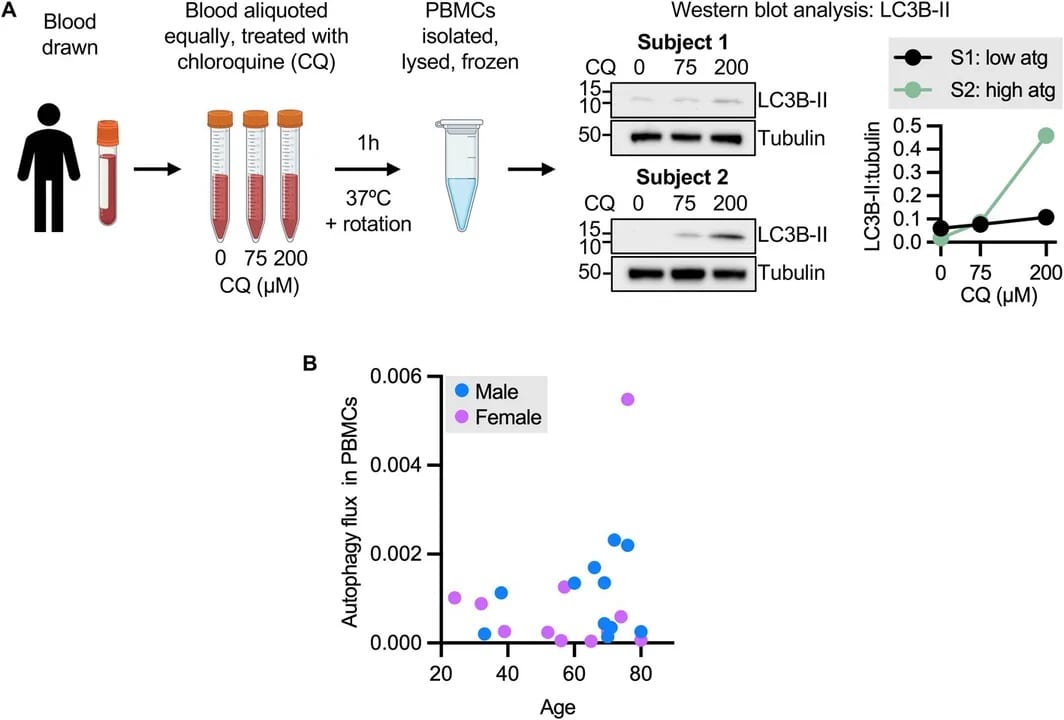
Most earlier work in people looked at which autophagy genes are switched on. This team also measured autophagy flux, the amount of recycling a cell actually does, in three kinds of human cells from a healthy aging cohort spanning roughly 23 to 80 years old. They used skin cells called fibroblasts, nerve cells grown from participants' own cells, and white blood cells taken fresh from a blood draw.
What they found
Autophagy genes became more active with age in skin cells, and less clearly in the nerve cells. But the recycling itself didn't follow the genes.
In skin cells, flux went down with age in men and stayed flat in women. In nerve cells, it rose with age in women. In white blood cells, it became more variable with age and tended to be higher in older people, in both sexes.
The link to health went in an unexpected direction. In adults over 70, higher autophagy flux was associated with weaker physical function. The authors suggest that, in older people, more recycling may be a response to stress in the cell rather than a sign of a healthier one.
A small exercise pilot
The team then measured five adults aged 77 to 88 before and after a 12-week fall prevention program, with one hour a week of mild exercise focused on balance, strength and posture. After the program, autophagy flux in their white blood cells was lower in four of the five, and their scores on a standard test of balance, walking speed and standing from a chair improved.
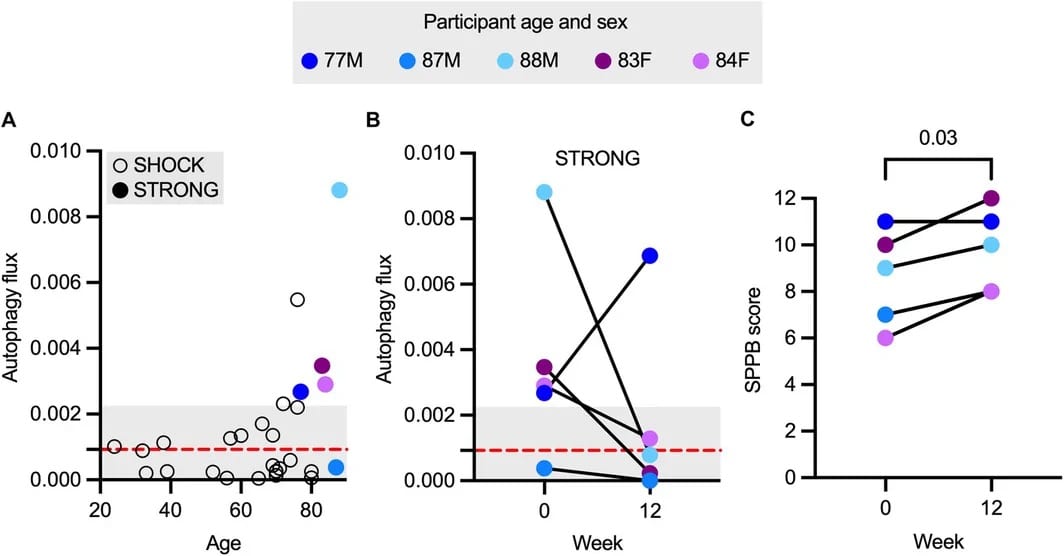
Five people is a pilot, not proof. The cohort is small too, and mostly white. The study shows associations, and it doesn't say what anyone should take or do. What it does challenge is the simple idea that more autophagy is always better, at any age.
Where Soma fits
The lesson we take from this is about direction. A marker that's good in one person or at one age can mean something different in another, so a single number rarely tells you much on its own. What tends to be more useful is how your own measures change over time, compared with your own baseline.
That's what we're designing Soma Axon for: a closed pod you'll visit once a week, with the same light, cameras and stance each time. Soma doesn't measure autophagy or anything at the cellular level, and it doesn't diagnose. It's a general wellness product meant to give you a consistent weekly record, with each value's margin of error shown. The same instrument, every week explains the idea.
Sources, as of October 13, 2026: Moreno, Kumsta and colleagues, Autophagy Flux Is Remodeled Sex- and Cell Type-Specifically During Human Aging, and Is Linked to Reduced Physical Function in Older Adults, Aging Cell (September 27, 2026), open access under CC BY 4.0; Sanford Burnham Prebys, release via ScienceDaily (October 13, 2026). This post describes research and isn't medical advice.