Compression gear in team sports: a faint signal, not a prescription
A meta-analysis in Applied Sciences pooled 18 studies of compression garments worn during and after exercise in team-sport athletes. Some broad domains leaned positive, but no specific outcome improved consistently, and the signal weakened when lower-quality studies were removed.
Soma Labs2 min read
Compression shorts, sleeves and socks are common in team sports. Players wear them during matches and afterwards, hoping to perform better or recover faster. A meta-analysis published on October 28 in Applied Sciences looked at what the evidence actually shows.
What was pooled
The authors, He, Li and Dong, searched ten databases through July 2026 and included 18 controlled studies. They covered team-sport athletes and tasks that resemble team sports, with compression worn either during exercise or during recovery.
They analysed the results in two ways. One looked at each outcome at each time point. The other grouped related outcomes into broader domains, such as performance or recovery. They also rated how certain each result was.
Where a signal showed up
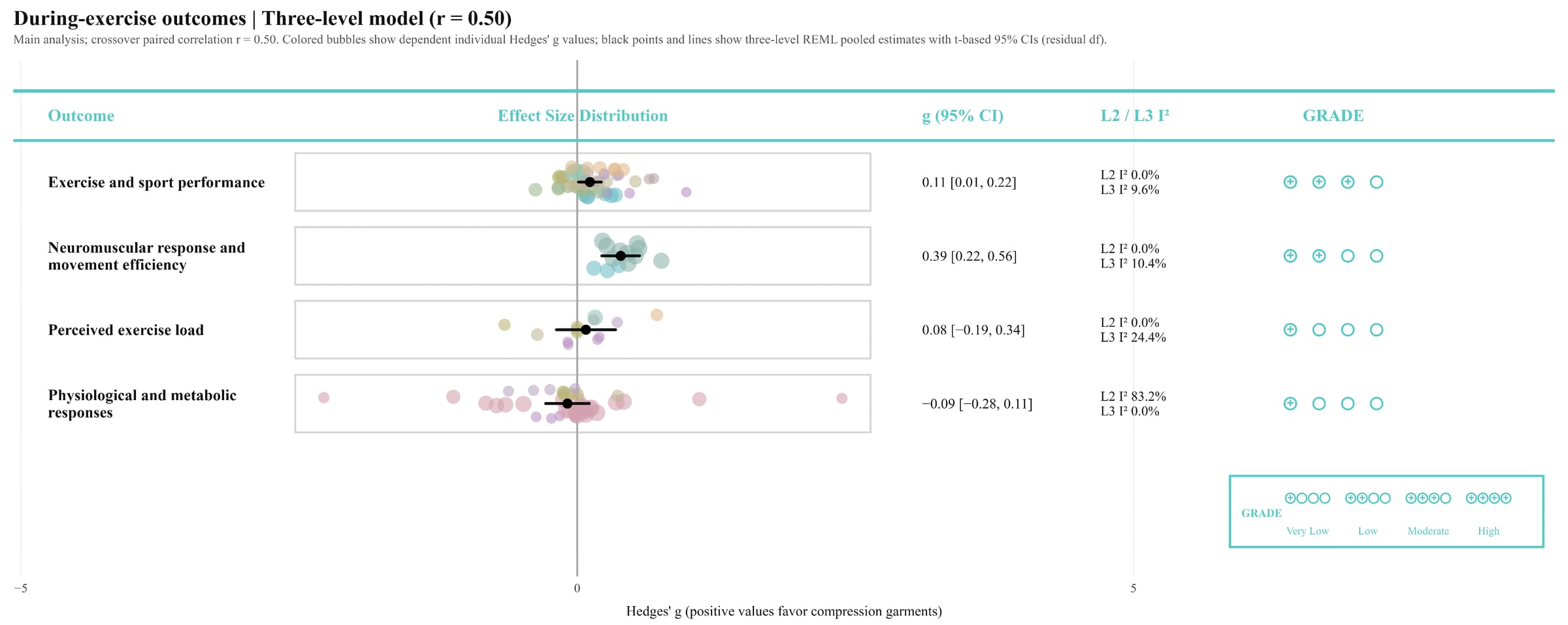
At the level of broad domains, three areas leaned in favour of compression.
Exercise and sport performance showed a very small effect, with a standardised size of 0.11. The authors rate the certainty of that as moderate. Neuromuscular response and movement efficiency showed a larger effect of 0.39, and perceived recovery after exercise, such as how heavy or tight the legs feel, showed 0.47. Both of those were rated low certainty.
Where it didn't
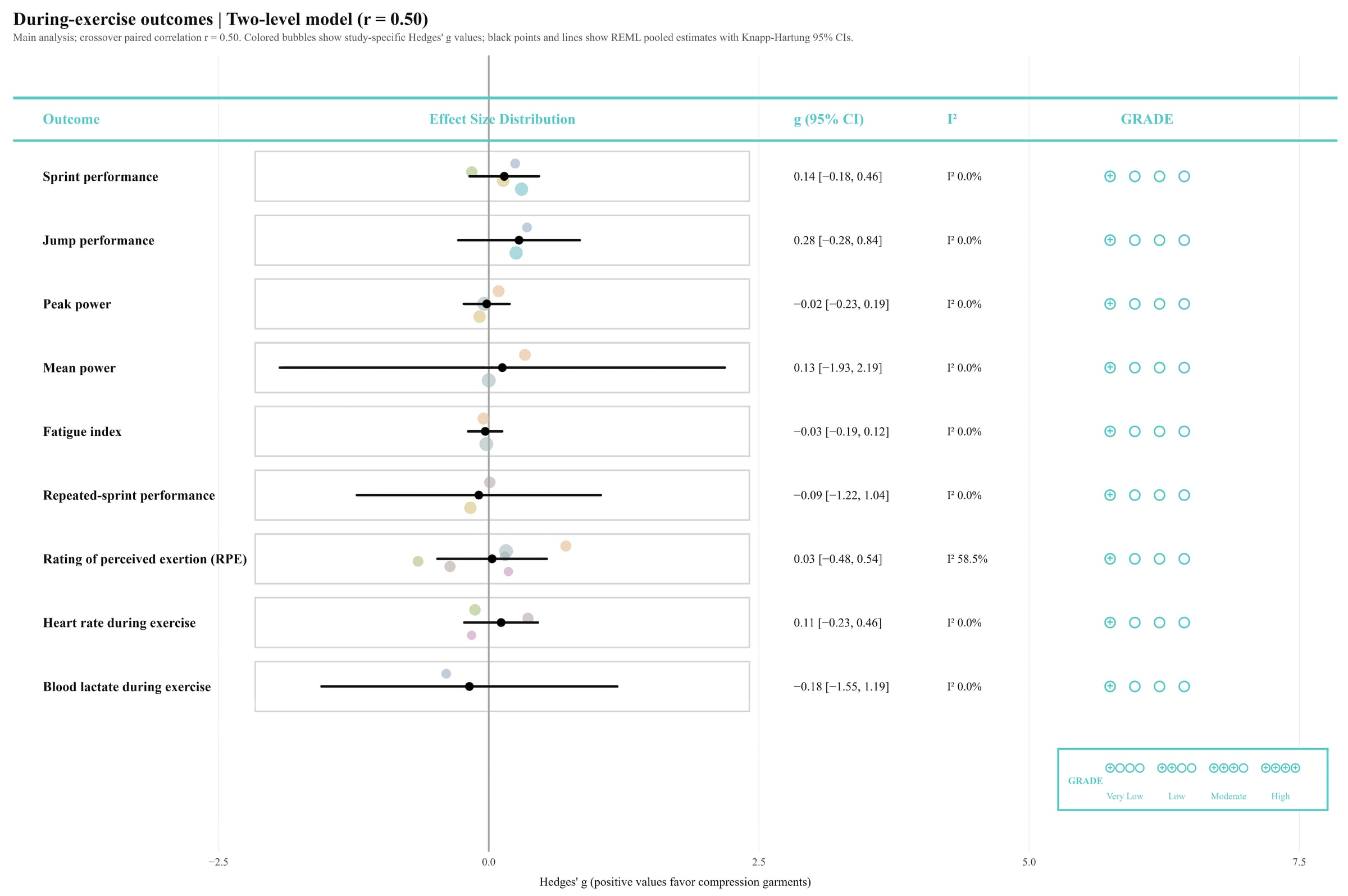
When the authors looked at specific outcomes, such as sprint times, jump height or particular recovery measures at specific time points, no outcome showed a consistent significant effect.
They also tested 22 possible explanations for why results might differ between studies, such as the type of garment or the timing. None of the 22 was significant.
And when they removed the studies judged at high risk of bias, the main positive findings weakened. That is often a sign that a pooled effect is partly carried by the weaker studies.
How to read it
The authors' summary is careful. Compression shows selective signals at the level of broad domains, not consistent gains in specific performance or recovery outcomes. They describe it as something that may be considered as a low-burden extra, and they say the evidence doesn't establish an optimal way to use it.
So the honest reading is narrow. If compression helps, the effect is small, uneven, and hard to pin to any one outcome.
Where Soma fits
Studies like this show how much depends on what you choose to measure and how. A broad, grouped measure can lean one way while each individual measure stays flat.
Soma is a general wellness product, not a medical device. It doesn't diagnose anything, and it doesn't measure performance or recovery. Soma Axon, the pod we are still building, uses the same light, cameras and stance every week, and shows each value with its margin of error, so a change over time is easier to trust. We wrote more about that in The same instrument, every week.
Sources, as of October 29, 2026: He, Li and Dong, Applied Sciences, published under CC BY 4.0. This post describes research and isn't medical advice.