Twelve years of weight in 8,209 German adults: income, partners and personality
A panel study in BMC Public Health followed adults aged 28 to 55 for about 12 years. BMI rose slowly, moving in with a partner went with a small gain, and the weights were self-reported.
Soma Labs3 min read

Most people's weight changes slowly enough that a single year tells you little. A study published in BMC Public Health on October 31 looked at a much longer stretch: about 12 years, in 8,209 adults in Germany.
The author, Felix Bittmann of the Leibniz Institute for Educational Trajectories in Bamberg, used the adult cohort of the National Educational Panel Study. People were 28 to 55 years old at the start, in 2011 and 2012. Their weight and height were then recorded six times, up to 2023 and 2024.
The study is exploratory, and the author says plainly that none of its associations should be read as cause and effect.

A slow climb
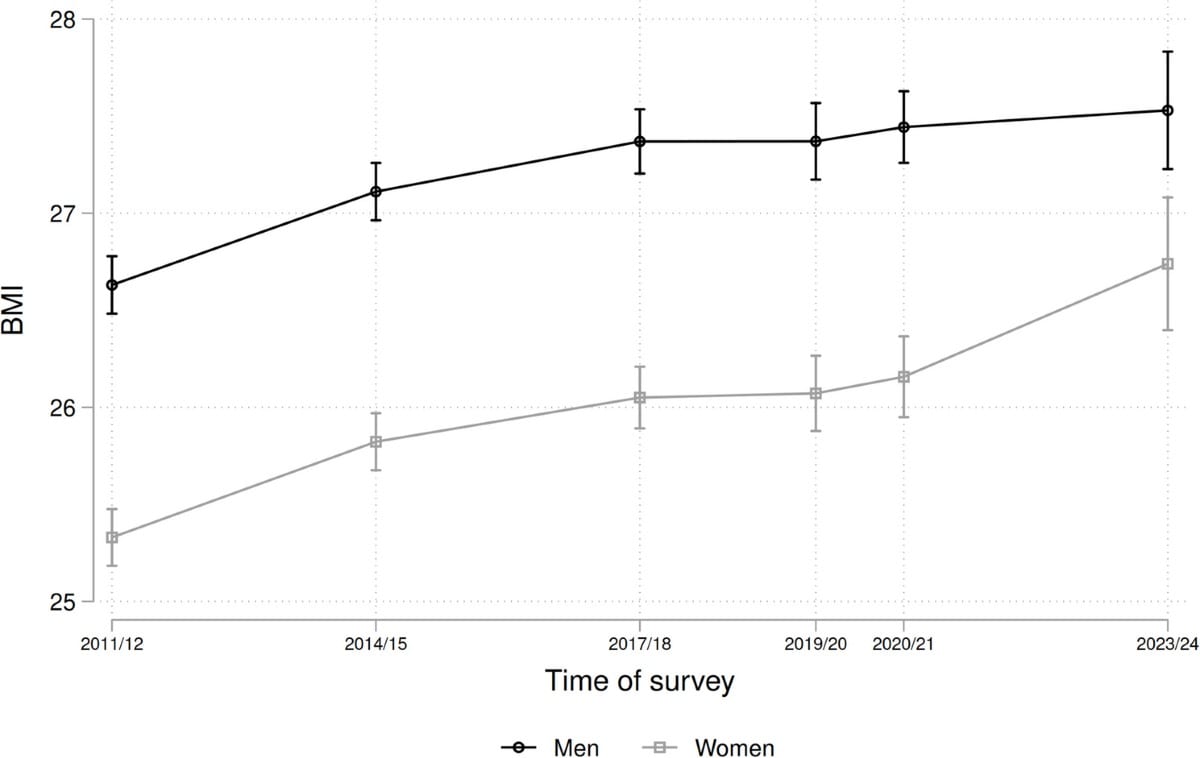
On average, BMI rose by about 0.08 points a year. The steepest part of the rise came in the first three years. Men had a higher average BMI than women in every wave. Women's average appeared to rise more steeply after 2020, and the author notes this may partly reflect changes in daily routines during the pandemic years, which the data can't test.
Who weighed what at the start
At the first wave, several things went with a lower BMI. These included higher household income, a university degree, a more advantaged family background, and more frequent sport. Among personality traits, conscientiousness had the strongest link with lower BMI. Extraversion went with a slightly higher BMI.
One result surprised the author. Higher neuroticism went with a lower BMI, not a higher one. The paper calls for this to be checked again with fuller personality measures, since the survey used a short 10-item version.
What changed within the same person
The more interesting analysis compares each person with themselves over time. That removes stable differences between people, like genes or upbringing.
Within the same person, moving in with a partner went with a BMI about 0.29 points higher. A rise in household income went with a slightly higher BMI, about 0.10 points. More sport went with a lower BMI, by about 0.13 points.
Smoking went with a lower BMI too, by about 0.52 points. The author reads this mostly as weight gained after people stopped smoking. The share of smokers in the sample fell from 30% to 20% over the period.
People with a university degree also saw their BMI rise a little more slowly.
The scale that wasn't there
There is one limit worth dwelling on. Every weight and height in this study was self-reported. The paper notes that people tend to under-report weight and over-report height, so self-reported BMI is usually somewhat lower than measured BMI, more so at higher body weights.
It means the absolute numbers are likely a little low.
Where Soma fits
Soma is a general wellness product, not a medical device. It doesn't diagnose anything, and nothing here is advice about weight. What this study shows is how much of our long-term picture still rests on what people remember and report. Soma Axon, the pod we are still building, uses the same light, cameras and stance every week, and shows each value with its margin of error, so a change over time is easier to trust. We wrote more about that in The same instrument, every week.
Sources, as of November 1, 2026: Bittmann, BMC Public Health, published under CC BY 4.0. This post describes research and isn't medical advice.